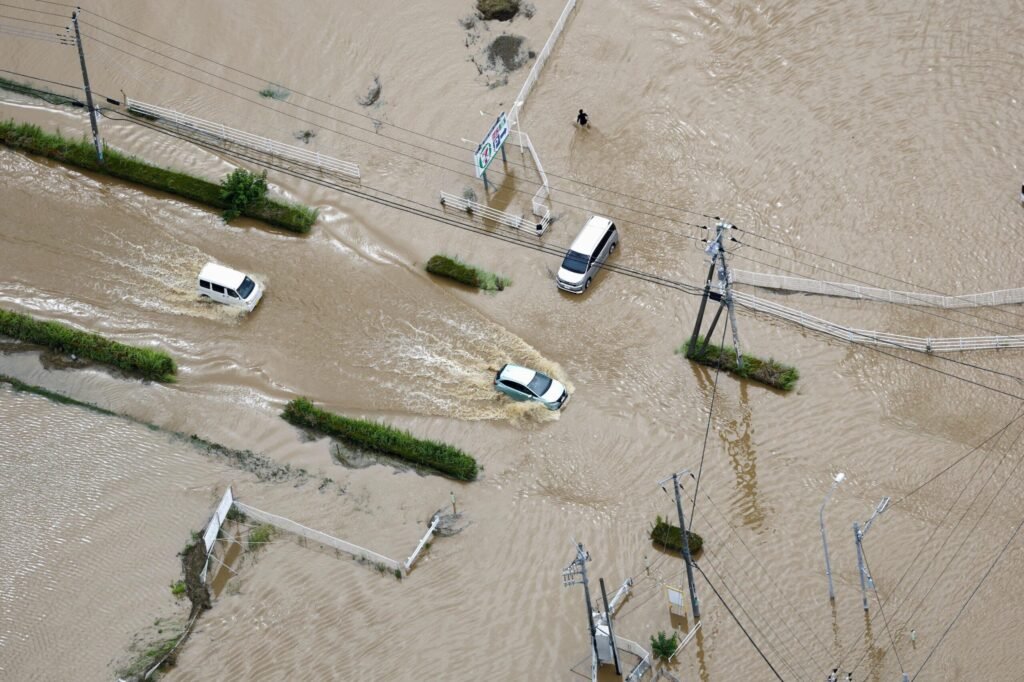
TOKYO, September 21, 2026 — A powerful typhoon has battered eastern Japan with torrential rain and violent winds, triggering the country’s highest-level landslide warning, forcing evacuations and disrupting hundreds of flights as authorities warn that further flooding and dangerous ground collapses remain possible.
Typhoon Dujuan swept past the Izu Islands and approached Japan’s Pacific coast on Monday, bringing severe weather to the Kanto region, which includes Tokyo and its surrounding prefectures.
What began as a warning about an approaching storm has developed into a dangerous emergency for several communities.
Landslides have already struck parts of Kanagawa and Chiba prefectures, mud has entered residential buildings, and emergency workers have been deployed to search for people who could not be contacted.
Japan’s Fire and Disaster Management Agency also reported one confirmed death in Miyazaki Prefecture and another person with minor injuries in its Monday afternoon assessment.
With enormous amounts of rain already soaking the ground, authorities are warning that the danger could continue even as the typhoon moves away.
More Than 670mm of Rain Falls as Japan Issues Highest Landslide Warning
One of the most serious developments occurred on Izu Oshima, an island south of Tokyo, where extraordinary rainfall prompted Japan’s weather agency to issue its highest-level emergency warning for landslides.
The island recorded 672.5 millimeters of rain in the 24 hours leading up to 4:40 p.m. Monday.
That is more than 26 inches of rainfall in a single day.
The Japan Meteorological Agency issued a Level 5 landslide emergency warning for Oshima at 12:40 p.m., signalling an immediate threat to life and urging residents to take emergency safety measures.
Emergency orders were also issued for several municipalities in Chiba Prefecture, including Ichihara, Kimitsu, Sodegaura, Sanmu, Sakura and Otaki.
The warnings reflect the dangers facing communities where prolonged rainfall has saturated hillsides and increased the possibility of sudden ground collapses.
Other parts of the Kanto region faced Level 4 warnings for heavy rain, flooding and landslides.
The emergency warning for Oshima was downgraded late Monday, but authorities continued to urge vigilance as the storm moved northeast.
Landslides Strike Homes as Emergency Workers Search for Missing Residents
The danger has already reached residential communities in parts of eastern Japan.
In Yokosuka and Miura, two cities in Kanagawa Prefecture, mud flowed into houses, apartment buildings and other structures during Monday afternoon.
Three female residents could not be contacted, prompting police and firefighters to begin search operations.
Their circumstances had not been confirmed in the available reports, and authorities had not established whether they had been injured.
Elsewhere, in Sodegaura, Chiba Prefecture, a man in his 50s was seriously injured while working to remove debris from a landslide.
The man reportedly fell down a cliff alongside the heavy machinery he was operating.
He was transported to hospital unconscious and in critical condition.
The incidents highlight a danger that can persist long after the heaviest rainfall has passed.
Saturated ground can remain unstable, placing residents, rescue personnel and cleanup workers at risk even when the sky begins to clear.
Why Japan Fears More Flooding Even as the Typhoon Moves Away
Japan’s weather agency has warned that intense bands of rainfall could continue developing over parts of eastern and central Japan.
These formations, known as linear rain bands, can repeatedly deliver heavy rain over the same location for several hours.
The consequences can be severe.
Rivers may rise rapidly, drainage systems can become overwhelmed, and hillsides weakened by prolonged rainfall may collapse with little warning.
Low-lying neighborhoods and communities near steep slopes face particular risks.
The threat is not limited to the locations directly beneath the storm’s center. Heavy rainfall can cause dangerous conditions across a much wider area.
Authorities have urged residents in affected communities to monitor evacuation instructions and remain cautious around flooded roads, swollen waterways and unstable ground.
Hundreds of Flights Cancelled as Storm Disrupts Japan’s Holiday Travel
Typhoon Dujuan has also caused widespread disruption to transportation and major events during Japan’s Silver Week holiday period.
Japan Airlines cancelled 120 domestic flights, while All Nippon Airways cancelled another 140.
Railway services were also affected, with East Japan Railway announcing suspensions on some routes in Chiba and Ibaraki prefectures and western Tokyo.
The disruption extended beyond travel.
Organizers of the Asian Games in Aichi Prefecture postponed an equestrian eventing competition until Tuesday because of the storm.
The Tokyo Game Show cancelled its Monday programme, bringing the event to an early conclusion.
Even Japan’s prime minister was affected.
Prime Minister Sanae Takaichi’s scheduled departure for New York to attend the United Nations General Assembly was delayed by four hours because of the severe weather.
The widespread disruption illustrates how the storm has affected daily life, international travel and major public events across the country.
What Happens Next as Typhoon Dujuan Moves Away From Japan?
As of 4 p.m. Monday, Typhoon Dujuan was approximately 130 kilometers southeast of Katsuura in Chiba Prefecture, moving northeast at around 35 kilometers per hour.
The storm was expected to move away from the Kanto region over waters to the east early Tuesday, September 22.
However, its departure does not necessarily mean an immediate end to the danger.
Japan’s weather agency forecast that parts of Kanto could receive another 200 millimeters of rain in the 24 hours ending Tuesday evening.
Additional rainfall was also possible across the Izu Islands, Tohoku and Tokai regions.
For communities already affected by landslides, flooding and damaged buildings, further rainfall could complicate recovery efforts and prolong the danger from unstable ground.
Authorities are continuing to urge residents to follow local safety instructions and avoid unnecessary travel through affected areas.
The immediate priority remains the safety of people in threatened communities, particularly those in areas where heavy rainfall has already weakened hillsides and overwhelmed drainage systems.
As Typhoon Dujuan moves away from Japan’s Pacific coast, the critical concern is whether the rain it leaves behind will trigger further flooding and landslides before conditions finally stabilize.