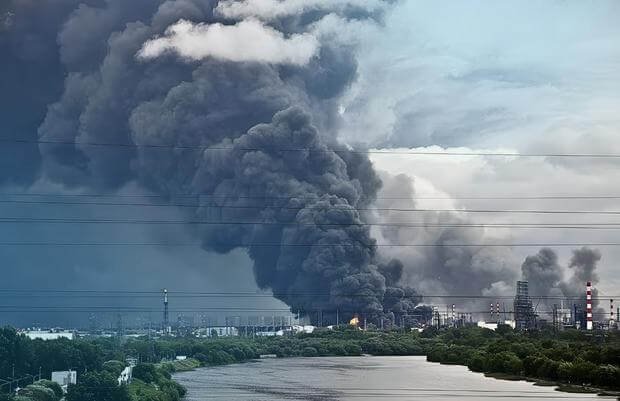
Large-scale Ukrainian drone attacks struck targets in and around Moscow on Thursday, triggering fires at oil-related infrastructure and bringing the effects of the war closer to the Russian capital than at almost any point since the full-scale invasion began.
Images and videos circulating on social media showed thick smoke rising above parts of Moscow after several explosions were reported near fuel and refinery facilities. Russian air defense systems attempted to intercept incoming drones, but damage was recorded at multiple sites, highlighting the continuing challenge facing Moscow’s efforts to shield critical infrastructure from long-range attacks.
The strikes came amid an intensifying exchange of aerial attacks between Russia and Ukraine. Kyiv has increasingly targeted energy, fuel, logistics and military-linked facilities inside Russia, while Moscow continues to conduct regular missile and drone assaults against Ukrainian cities and infrastructure.
Ukrainian President Volodymyr Zelensky described the operation as part of a response to sustained Russian attacks on Ukraine. The latest escalation follows recent strikes on Kyiv and other urban centers, underscoring the growing role of long-range drone warfare in the conflict.
While the full extent of the damage in Moscow remains unclear, analysts say attacks on refinery and fuel facilities can have consequences beyond the immediate destruction, potentially affecting supply chains, transportation networks and military logistics. Russian authorities have not publicly detailed the scale of any disruption.
The incident also renewed scrutiny of Russia’s domestic security posture. Moscow has invested heavily in layered air-defense systems intended to protect the capital and key government institutions. Repeated drone incursions, however, have demonstrated that Ukrainian unmanned aircraft remain capable of reaching high-value targets deep inside Russian territory.
The latest attack occurred as diplomatic efforts to end the war continue to show little progress. Discussions among Western leaders at recent international meetings have focused on military assistance for Ukraine, sanctions on Russia and potential pathways toward negotiations. Despite periodic references by both Moscow and Kyiv to a future settlement, no breakthrough has emerged.
Recent comments from Russian President Vladimir Putin have suggested that Moscow remains committed to its military objectives while also leaving open the possibility of eventual talks. At the same time, Russian forces continue operations along several sectors of the front line, where fighting remains intense despite limited territorial changes in many areas.
Ukraine, meanwhile, has sought to expand its domestic defense production capacity as Western governments confront challenges in replenishing weapons stockpiles. Ukrainian officials have emphasized the importance of increasing local manufacturing of air-defense systems, drones and other military equipment to sustain the country’s war effort.
The conflict has increasingly evolved into a contest of industrial capacity, long-range strike capabilities and economic endurance. Ukrainian attacks on Russian energy infrastructure have become a central element of Kyiv’s strategy, aiming to complicate military logistics and impose economic costs beyond the battlefield.
Inside Russia, the war has generated growing pressure on infrastructure and the economy. Authorities have acknowledged disruptions linked to Ukrainian attacks, while measures such as internet restrictions and enhanced security protocols have become more common in some regions.
Military analysts note that Moscow faces limited options for significantly escalating the conflict without increasing strategic risks. Direct confrontation with NATO members would carry substantial consequences, while the use of more extreme military measures could provoke broader international responses.
For now, attention is focused on the aftermath of the strikes and whether further attacks follow in the coming days. Investigations into the damage are ongoing, and officials have not released comprehensive assessments of losses at the affected facilities.
As both sides continue to rely heavily on drones and long-range weapons, the latest events around Moscow illustrate how the war’s reach extends far beyond the front lines, affecting critical infrastructure, national economies and the broader strategic calculations of both governments.